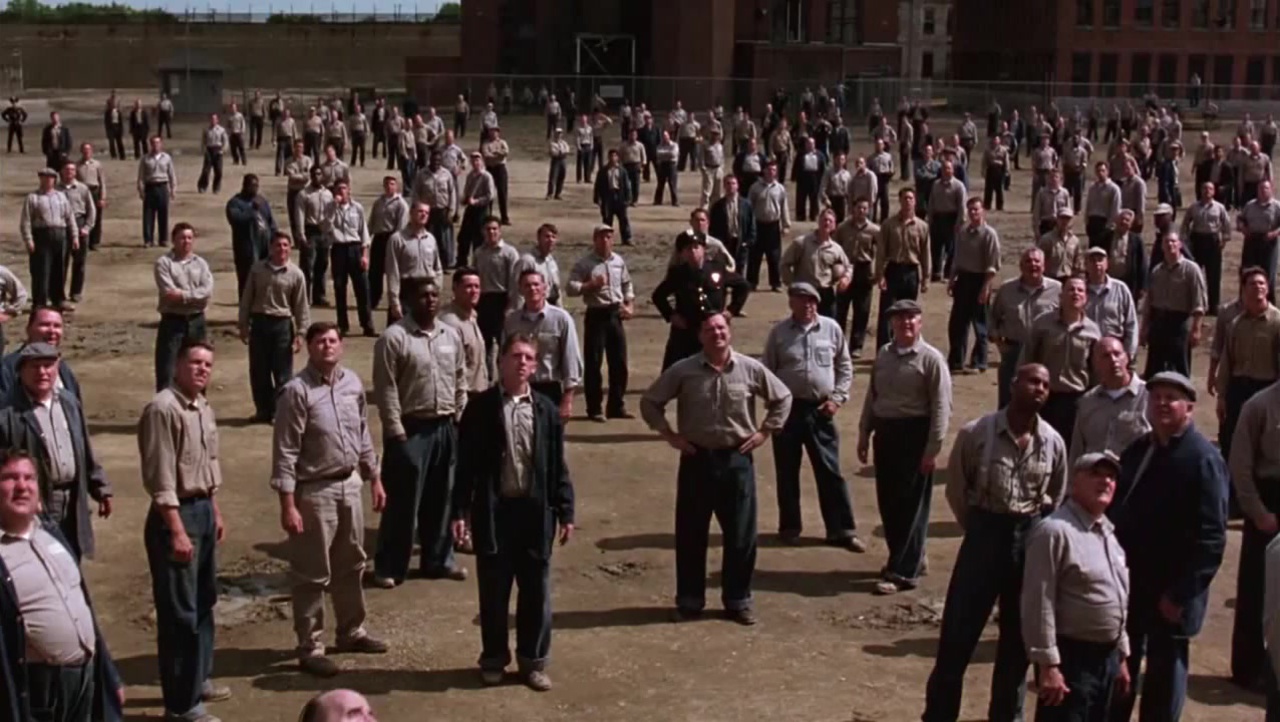
Image from The Shawshank Redemption (1994). Directed by Frank Darabont.
As I watch this operatic scene from The Shawshank Redemption once again, I am brought back to those initial feelings I’d had when I had first seen the movie — empathy, hope, a sense of humanity. Although watching this particular clip on its own is indubitably moving, it means so much more in context; seeing how this scene contrasts with the tragedy and turmoil that encompasses the other scenes of the movie demonstrates how touching this scene is for the prisoners: just for this singular moment in all their years stuck in the prison, they feel — as Red words it — “free”.
There’s a noticeable shift that occurs when Andy plays the aria for the camp; it’s one of his first acts of rebellion, making us think that it must’ve been something he thought was worth the consequences. His punishment was two weeks in the hole — a dark room of solitary confinement — but he describes it as “the best time he ever did”. It’s obvious that the other prisoners were afraid to admit how moved they were by the aria — perhaps out of fear of seeming feminine. However Andy recognizes the true power behind a singular song:
“Here’s [the prison] where it makes the most sense. You need it so you don’t forget — forget that there are places in the world the aren’t made out of stone. That there’s something inside that they can’t get to — that they can’t touch. It’s yours.”
Although it’s obvious that Andy tacitly understands how the aria must have affected the other prisoners and guards, the impact was also quite clear on their faces. Every person at the prison stopped what they were doing to listen to that operatic song; for that one moment, there were no guards, no prisoners, no warden. There was simply them and the music, a universal bond among people. Red even admits that he has “no idea to this day what those two Italian ladies were singing about”; however, in that moment, it didn’t matter. Those prisoners were perfectly content with the aria in its most basic form.
I do wonder, however, if the translation was in any way connected to the experience of the prisoners. I’ve discovered that Sull’aria is a duettino in Le nozze di Figaro between a servant (Susanna) and the Countess, in which the two work together to plot against the Count, in order to expose his infidelity. On the surface, it’s difficult to see how this situation could relate to the circumstance of the prisoners of Shawshank. However, when reading the lyrics and situation more closely, there are a few distinguishable parallels.
For starters, there is the obvious inferiority complex. Because the opera premiered in 1786, there were obvious gender norms and expectations established by society in which the hierarchy stated that women did not hold the same power that men did. However, in Sull’aria, the two women evidently attempt to outwit the male characters, thus proving their cleverness and stealth. The english translations discuss the women trying to “catch him [the Count] in our trap” which was an extremely risky move for women during that time period. When applying this inferiority complex to the movie, we see that there is not only a societal but legal hierarchy established at the prison, in which the prisoners are at the bottom of the pyramid. Perhaps on a subconscious level, this song is source of inspiration for the prisoners to give them hope that rebellion is not as impossible as they think. Perhaps the risks of Susanna and the Countess sparked a sense of rebellion within the prisoners. Maybe Andy Dufrey’s risk to play to music was a sign that they too have the ability to take risks against the guards and ultimately outwit their superiors.
Secondly, there’s the concept of an unlikely bond. The improbable friendship that developed throughout the song between the Countess and Susanna over their shared goal to expose the Count parallels the unlikely bond that forms between the prisoners and the guards over the aria. Because hearing the song momentarily exposed a bit of their soul, every individual at that prison is connected by collectively baring their own humanity — even just for a moment. We see in the clip, that the guards that were previously attacking and scolding the prisoners have united with them in an attempt to soak in as much of the music’s beauty as possible.
Additionally, the thematic idea of illusion is present in both the duettino and the movie, although the concept takes different forms in each. In the aria, although the music is beautifully eloquent and seemingly heart-wrenching, the lyrics imply a scheme in the works. Therefore, the beauty behind the lyrics has underlying tones of illusion and deception. This same illusion is apparent in the scene in The Shawshank Redemption. Although the men were momentarily bonded by the feeling of being “free”, that feeling was merely an illusion. When the song was cut off by the warden, the prisoners were forced to return to reality and their lives of brutality and hopelessness. Therefore, Red and the other prisoners were deceived by a glimpse of hope in their never-ending dungeon of despair — both literally and metaphorically.
Although Red states that he “[doesn’t] want to know” what the aria’s lyrics meant, there is a possibility that he and the other prisoners knew exactly what they were listening to on a subconscious level. It’s difficult to say whether I myself would want to know the meaning behind the opera if I were in their shoes. Maybe the music in its most pure form was all they needed to persevere for a little longer. Maybe that single song was what got most of those prisoners through the next few years at Shawshank. And maybe that glimpse of hope that we as humans hear in music everyday keeps us going for just a little bit longer.
 Leighann's Opera Immersion Blog
What a great interpretation of the song’s connection to the movie! I can definitely get behind the idea that the song acted as a mechanism to “free” the inmates from the inhumanity of prison. As you nicely describe, the song creates a contrast from the bleak world that exists in the other scenes of the movie. I had not thought of it before, but I agree that the inmates were most likely afraid to admit that they were moved by the song out of fear of being too feminine. The prisoners have to learn to be tough while behind bars, so admitting that the aria moved them could have revealed a softer side that they want to hide. I feel that this fear is still present in today’s society when it comes to an appreciation of the arts, especially in younger age groups or in groups of “masculine” men. Education about opera could be the solution to getting more people to appreciate the art, rather than ignoring it because of its label.
I also wrote about this unlikely bond that you mention as a connection between the song and the movie. The music joins two individuals or groups from different social statuses and allows them feel similar emotions. It breaks down the social structures that exist, which often happens with music as a whole. Also, as you eloquently wrote, a single song can give “that glimpse of hope that we as humans hear in music everyday keeps us going for just a little bit longer.” The song does that for the characters in the aria, the prisoners in the movie, and people in the real world looking for some solace in the hectic world.
LikeLike
Correction: Also, as you eloquently wrote, a single song can give “that glimpse of hope that we as humans hear in music everyday [which] keeps us going for just a little bit longer.”
LikeLike
I really like your ideas here Leighann, and JV did a great job in responding to them. One thing that I especially liked was your comments on the gender norms depicted in the aria. It’s a big theme in this opera, and it’s something we will want to explore in La Fille du Regiment too. Great job bringing out this aspect of the social-cultural context.
LikeLike